
Diamonds & Dancefloors #3
Za cijeli broj  podij ima oblik jednakostraničnog trokuta stranice
 , podijeljenog pravilnom trokutastom mrežom na jedinične jednakostranične trokute. Odaberemo jednu visinu podija. Jedinične trokute kroz čiju unutrašnjost prolazi ta visina označimo, redom od vrha prema osnovici, s
 .
Na raspolaganju imamo točno po jednu trapeznu pločicu  . Pločica
 jednakokračni je trapez osnovica duljina
 i
 te krakova duljine
 ; sastoji se od jednog reda od
 jediničnih trokuta. Na slikama je prikazan podij za
 i pripadajuće tri pločice.
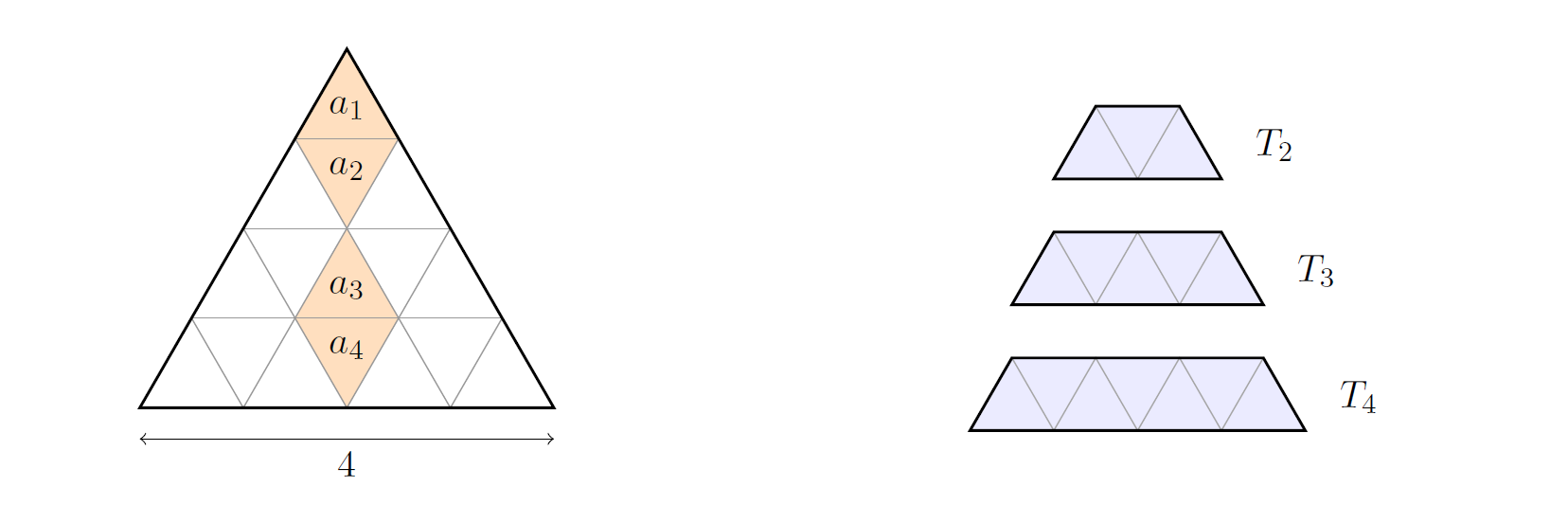
Jedno od polja  mora ostati nepokriveno jer je ondje predviđeno mjesto za svjetlosni efekt. Ostatak podija treba potpuno prekriti svim raspoloživim pločicama, bez preklapanja i bez izlaska izvan podija. Pločice smijemo zakretati, a svaka mora prekrivati cijela polja trokutaste mreže.
Neka je  ukupan broj takvih popločavanja, pri čemu brojimo i izbor nepokrivenog polja i raspored pločica. Podij je u fiksnom položaju: rasporede dobivene zakretanjem ili zrcaljenjem ne poistovjećujemo, osim ako su zauzeta polja svake pločice ista.
Odredite ostatak pri dijeljenju broja  brojem
 .
For an integer  , the dance floor is shaped like an equilateral triangle with side length , divided by a regular triangular grid into unit equilateral triangles. We select one altitude of the dance floor. Let
 denote the unit triangles through whose interiors this altitude passes, ordered from the vertex to the base.
We have exactly one trapezoidal tile of each type  at our disposal. Tile is an isosceles trapezoid with bases of lengths and and legs of length ; it consists of a single row of unit triangles. The images show the dance floor for and the corresponding three tiles.
One of the cells  must remain uncovered, as a space for a lighting effect is designated there. The rest of the dance floor must be completely covered using all the available tiles, without overlapping and without extending beyond the boundaries of the dance floor. The tiles may be rotated, and each must cover complete cells of the triangular grid. Let be the total number of such tilings, where we count both the choice of the uncovered square and the arrangement of the tiles. The board is in a fixed position: arrangements obtained by rotation or reflection are not considered identical, unless the sets of squares occupied by the tiles are the same.
Determine the remainder when is divided by .