Obnova je završena i vrijeme je za ples! U sljedećoj dvorani čeka vas jednakostraničan plesni podij s istom vrstom trokutaste mreže. Ovaj put važna su sjecišta linija, a ne trokutasta polja.
Za pozitivan cijeli broj  svaka je stranica podija podijeljena na jednakih dijelova. Kroz diobene točke povučene su dužine paralelne stranicama, pa je podij podijeljen na
 manjih jednakostraničnih trokuta. Plesači mogu stajati u njihovim vrhovima, uključujući točke na rubu velikog trokuta, pri čemu na svakom mjestu može stajati najviše jedna osoba.
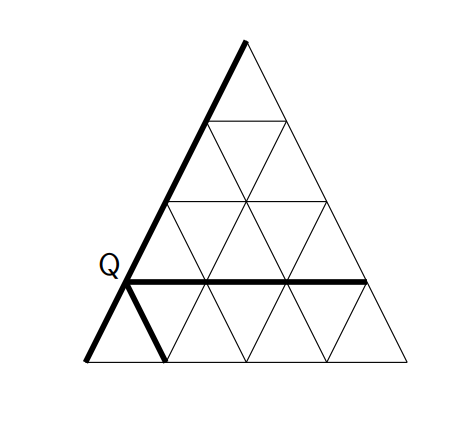
Pravila ove plesne igre neobična su (iako nama matematičarima već standardna): nijedna dva plesača ne smiju se vidjeti. Dva se plesača vide ako pravac kroz njihova mjesta ima jedan od triju smjerova stranica podija. Ostali plesači ne zaklanjaju pogled.
U ovom zadatku neka  označava najveći mogući broj plesača koje možemo istodobno rasporediti na takav podij poštujući navedeno pravilo.
Odredite ostatak pri dijeljenju broja  brojem
 .
The renovation is complete, and it is time to dance! An equilateral dance floor awaits you in the next hall, featuring the same type of triangular grid. This time, the intersections of the lines matter, rather than the triangular regions themselves.
For a positive integer , each side of the dance floor is divided into equal segments. Line segments parallel to the sides are drawn through the division points, dividing the floor into smaller equilateral triangles. Dancers can stand at the vertices—including those on the boundary of the large triangle—with at most one person occupying any single position.
The rules of this dance game are unusual (though standard for us mathematicians): no two dancers may see each other. Two dancers see each other if the line passing through their positions aligns with one of the three directions of the dance floor's sides. Other dancers do not obstruct the view.
In this problem, let denote the maximum possible number of dancers that can be simultaneously arranged on such a dance floor while adhering to the stated rule.
Determine the remainder when is divided by .
[lang=hr]
Obnova je završena i vrijeme je za ples! U sljedećoj dvorani čeka
vas jednakostraničan plesni podij s istom vrstom trokutaste mreže.
Ovaj put važna su sjecišta linija, a ne trokutasta polja.
Za pozitivan cijeli broj $n$ svaka je stranica podija podijeljena
na $n$ jednakih dijelova. Kroz diobene točke povučene su dužine
paralelne stranicama, pa je podij podijeljen na $n^2$ manjih
jednakostraničnih trokuta. Plesači mogu stajati u njihovim vrhovima,
uključujući točke na rubu velikog trokuta, pri čemu na svakom mjestu
može stajati najviše jedna osoba.
\includegraphics{Q.png}
Pravila ove plesne igre neobična su (iako nama matematičarima već standardna): nijedna dva plesača ne smiju
se vidjeti. Dva se plesača vide ako pravac kroz njihova mjesta ima
jedan od triju smjerova stranica podija. Ostali plesači ne zaklanjaju
pogled.
U ovom zadatku neka $f(n)$ označava \emph{najveći mogući broj
plesača} koje možemo istodobno rasporediti na takav podij poštujući
navedeno pravilo.
\textbf{Odredite ostatak pri dijeljenju broja $f(2026)$ brojem $100$.}
[/lang]
[lang=en]
The renovation is complete, and it is time to dance! An equilateral dance floor awaits you in the next hall, featuring the same type of triangular grid. This time, the intersections of the lines matter, rather than the triangular regions themselves.
For a positive integer $n$, each side of the dance floor is divided into $n$ equal segments. Line segments parallel to the sides are drawn through the division points, dividing the floor into $n^2$ smaller equilateral triangles. Dancers can stand at the vertices—including those on the boundary of the large triangle—with at most one person occupying any single position.
\includegraphics{Q.png}
The rules of this dance game are unusual (though standard for us mathematicians): no two dancers may see each other. Two dancers see each other if the line passing through their positions aligns with one of the three directions of the dance floor's sides. Other dancers do not obstruct the view.
In this problem, let $f(n)$ denote the \emph{maximum possible number of dancers} that can be simultaneously arranged on such a dance floor while adhering to the stated rule.
\textbf{Determine the remainder when $f(2026)$ is divided by $100$.}
[/lang]
